Step 1 — Prepare a clean photo
Use a straight-on, front-facing photo taken at arm's length. Keep your head upright, pull hair back so your temples and jaw are visible, and use even lighting. A mirror works too — just look straight ahead, not down.
Your face shape is simply the relationship between four measurements: face length, forehead width, cheekbone width, and jaw width. Measure those four distances, compare the ratios, and you can match yourself to one of the seven common shapes — or use our free browser-based face shape test to do it automatically in seconds.
If you want to know how to determine your face shape without guessing, it comes down to four measurements and one simple ratio. A ruler, a mirror or even a front-facing photo is enough. The six steps below walk you through it, or skip straight to our free AI face shape test if you'd rather let the browser do the work in under 30 seconds.
Use a straight-on, front-facing photo taken at arm's length. Keep your head upright, pull hair back so your temples and jaw are visible, and use even lighting. A mirror works too — just look straight ahead, not down.
Measure from the center of your hairline down to the bottom of your chin. This is your vertical reference point. If the hairline is hard to see, estimate from a photo.
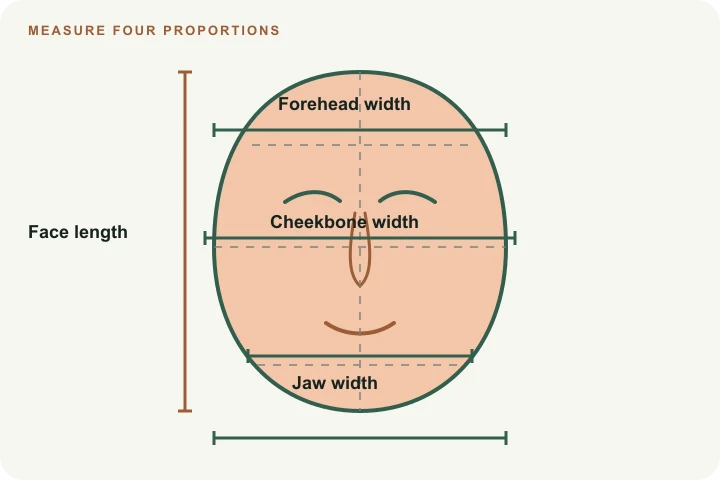
Measure across the widest part of your forehead, roughly between the temples. Not the brow line — the forehead's widest sweep is higher up, just below the hairline.
Measure across your face at the widest point of your cheekbones, usually just below the outer corner of each eye. This is the key mid-face width that other measurements get compared against.
Measure from one jaw angle to the other. If you can feel a distinct corner where your jaw turns upward, that's the point. A soft or rounded jaw with no clear corner is itself a strong signal.
Divide face length by cheekbone width. A ratio around 1.5 with a gently tapered jaw suggests oval. A ratio near 1 with full cheeks suggests round. Equal widths with an angular jaw suggests square. The widest section tells you the rest: forehead → heart, cheekbones → diamond, jaw → triangle, and clearly longer than wide → oblong.
Wide-angle selfies exaggerate the center of the face. Smiling widens the cheeks and rounds the jaw. Bangs or a tilted head hide the hairline or change the forehead line. Shadows can make the jaw look narrower than it is.
| Measurement | Where to measure | What it tells you |
|---|---|---|
| Face length | Hairline center to chin tip | Your vertical scale — the reference for length-to-width ratio |
| Forehead width | Widest point, roughly between the temples | Upper third balance; the widest section on heart shapes |
| Cheekbone width | Widest point under the outer corner of each eye | Mid-face width — the main comparison point for all other measurements |
| Jaw width | From one jaw angle to the other | Lower third strength; angular vs soft, widest section on triangle shapes |
| Shape | Length : width | Forehead | Cheekbones | Jaw |
|---|---|---|---|---|
| Oval | ≈ 1.5 | Balanced | Slightly wider | Gently tapered |
| Round | ≈ 1 | Balanced | Full | Rounded, soft |
| Square | ≈ 1 | Similar | Similar | Angular, defined |
| Heart | Wider at top | Widest | Medium | Narrow, pointed chin |
| Diamond | Longer | Narrower | Widest | Narrow |
| Oblong | > 1.5 | Balanced | Balanced | Long, straight |
| Triangle | Wider at bottom | Narrower | Medium | Widest, angular |
Your face shape is the starting point for almost every styling decision. The right hairstyle balances a long face, the right glasses frame softens a square jaw, and knowing your proportions helps with beard lines, makeup contour placement and even choosing a hat. Four quick measurements give you a foundation for every styling choice you'll make.
Once you know your proportions, you can make styling decisions with more confidence instead of following a generic rule. Someone with a longer face may prefer movement at the sides, while someone with a strong jaw may like softer layers or rounded frames. These are practical starting points, not strict rules. Hair texture, personal taste, and the way you wear your hair can matter just as much as the numbers. Use the measurements to understand balance, then choose the look that feels like you.
Think of the four numbers as a conversation between the upper, middle, and lower thirds of your face. Width alone does not define a shape: two people can share a cheekbone measurement but look completely different because one has a rounded jaw and the other has sharp angles. Looking at the relationship between measurements gives a clearer answer than measuring one feature in isolation. That balanced view is especially useful when comparing hairstyles, glasses, and facial-hair options.
Most people aren't a perfect textbook match. Many faces combine an oval length with round cheeks, or a square jaw with a heart-shaped hairline. Treat the result as a range, not a verdict. The free face shape test on our homepage shows the confidence split between your top matches, so you can pick the styling that works for the closer shape or for both.
For the most useful comparison, repeat the measurement with two or three well-lit photos rather than trusting one snapshot. Keep the camera at eye level, stand a little farther away, and avoid a wide-angle front camera. If the same pattern appears in each image, your result is more meaningful. If the results shift, that usually reflects pose, lens distortion, hair placement, or a softly defined jaw rather than a problem with the tool. In those cases, treat the two closest shapes as a styling range and explore advice for both.
It also helps to compare the shape of your face with and without styling. Pull hair away from the temples, remove sunglasses, and keep your expression relaxed. Makeup, facial hair, bangs, and strong shadows can change what appears to be the widest point. A consistent process makes it easier to see the underlying proportions. You do not need perfect precision: the goal is to find useful direction for a haircut, frame, or accessory, not to assign a permanent label.
Take our free face shape test to find out in seconds.
Four: face length (hairline to chin), forehead width, cheekbone width, and jaw width. The relationship between them decides the shape.
Compare face length to cheekbone width. Near 1.5 with a soft jaw = oval; near 1 with full cheeks = round; similar widths with an angular jaw = square; widest at the forehead = heart; widest at the cheekbones = diamond; widest at the jaw = triangle; clearly longer than wide = oblong.
A close-up wide-angle selfie can distort proportions. Take the photo at arm's length, camera at eye level, hair pulled back, and neutral expression.
A ruler gives you control but has the same risk of misreading landmarks. A browser detector compares the same four points automatically and shows you the values — and never uploads your photo.
Most faces sit between two categories. Focus on your strongest feature — usually the jaw or the widest section — and pick the closer match. Styling advice for adjacent shapes overlaps heavily, so the practical difference is smaller than you'd think.
Under 30 seconds. Upload a photo and the browser runs facial landmark detection locally — your photo is never uploaded to any server.